
Win your first freelance client in six weeks. Earn £960 to £1,450+ a month, without leaving your job.
Six-week live coaching programme for employed marketers in any specialism - if a client would pay for what you already do at work, this teaches you how to sell it. Each retainer runs £300–£800 a month; three or four of them, 6 months on, and they're each billing £960 to £1,450 a month - all still employed full-time.
No obligation · 8 seats · Starts 29 January
The transformation
Where you are now. Where this ends.
Right now
Six weeks from now
You run campaigns that bill at £350–£500 a day. You see about £23 an hour of it.
A packaged offer built on the skill you already have, with your price on it.
Your skill has a price on it and somebody else sets it.
A list of clients worth approaching and the messages to send them.
You've thought about freelancing for months and never known what to charge or who to ask.
A discovery call structure you've rehearsed out loud, not just read.
Every guide you've read assumes you have forty hours a week. You have four.
The goal: a signed first client. Some get there in week three. Some don't get there inside six - I'll be straight with you about that on the call.
The markup
Your work leaves your desk at £23 an hour and arrives at the client at £400 a day.
Here's what actually happens. You build the campaign. It ships under your employer's name, or an agency's, and it gets billed at a day rate you never see a line of. Same campaign. Same hands. Different invoice.
Nobody's doing anything wrong. That's the deal employment makes: you trade the upside for the certainty, and for a lot of people that's a fair trade.
The problem is that most people with a billable skill think it's the only deal on offer. It isn't. There is a live market paying £350–£500 a day for exactly what you already do, and it doesn't require you to quit anything, build an audience, or become a different person.
What stops people isn't the skill. It's that nobody ever told them what their hour is worth, who's buying it, or what to say when someone asks for a price.
That's a six-week problem, not a career problem.
Fit
Any marketing specialism. Here's what that means.
- Paid media / PPC
- SEO
- Social media
- Email & CRM
- Content & copywriting
- Analytics
- Ecommerce
- Brand & comms
- Marketing generalist
There isn't a list you need to be on. If you're employed doing marketing work a client would pay for, the mechanics are the same.
If you're employed doing any of these, the mechanics are identical. The channel changes; the pricing conversation doesn't. My own background is paid media - that's the example I'll use most - but what this cohort teaches is how to package, price, find and close, and that's the same whether you're selling PPC, social media management, or a content retainer.
Generalist marketing managers often do best here, because you've got more than one thing you could sell and we can pick the one clients actually pay for.
What it doesn't do is teach you marketing. You need the skill already. That's the one hard requirement.
The proof
My receipts, their results, and what the market pays.
I've never been a full-time freelancer. Never built a personal brand, never quit anything, never sold a course before this one. I'm a working digital marketer who bills clients on the side - and I've been doing it for over a decade.
A client pays me $90 an hour for the same work my day job pays me a salary to do.
$12,510 at $90/hour
139 hours across seven weeks - the one contract here that wasn't part-time. I was effectively working two jobs that autumn. It's on this page because it shows the ceiling if you decide to push; every other contract shows what four hours a week looks like.
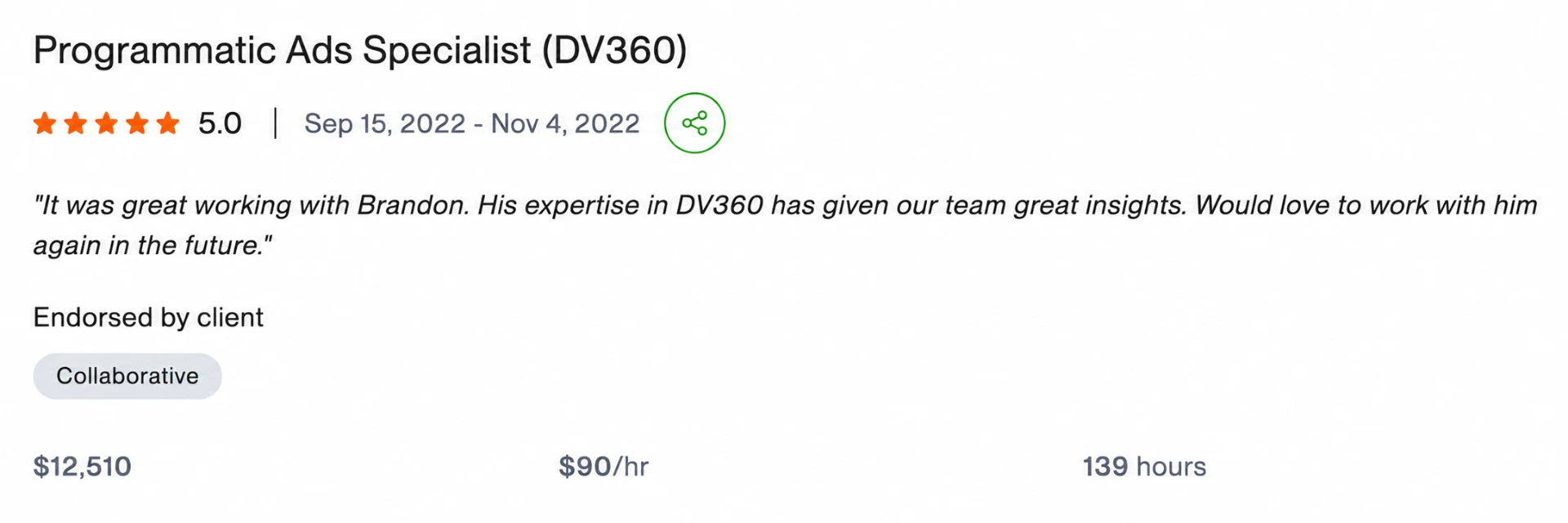
“It was great working with Brendan. His expertise in DV360 has given our team great insights.”
$9,211.10 at $80/hour
115 hours and still running. A live contract, billed at $80 an hour, alongside a full-time job.
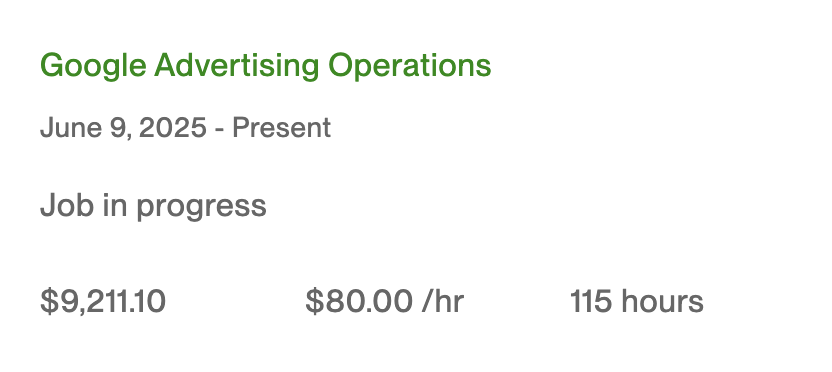
That's $43,005 across eight contracts on one platform, all of it around a full-time job. A single client has paid me £13,000. My best freelancing year was £67,000. I'm still running paid media on retainer right now, for 3 clients at £3,650 a month personally.
$5,815.28 at $75/hour
78 hours across four months. About 4.4 hours a week. Five stars.
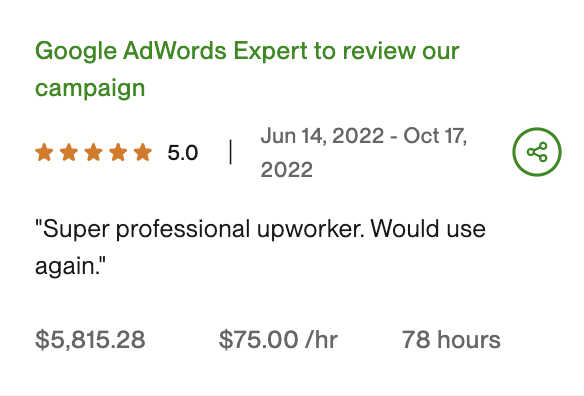
“Super professional upworker. Would use again.”
$3,586.60 at $60/hour
61 hours across three months. About 4.1 hours a week. Five stars.
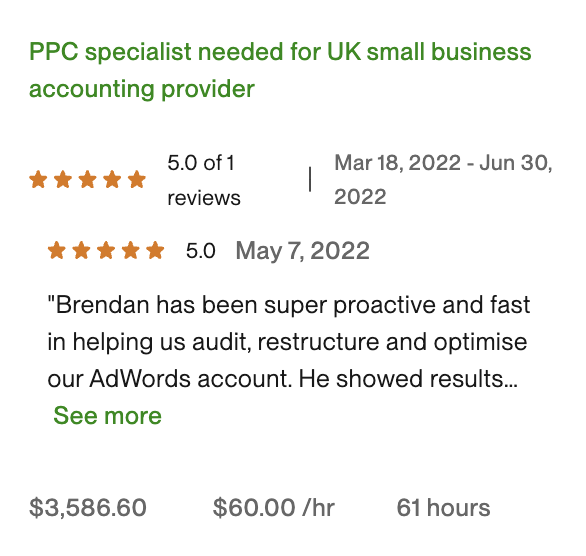
“Super proactive and fast in helping us audit, restructure and optimise our AdWords account.”
$2,959.40 at $90/hour
34 hours, gambling affiliate Google Ads. In progress. My highest verified rate.
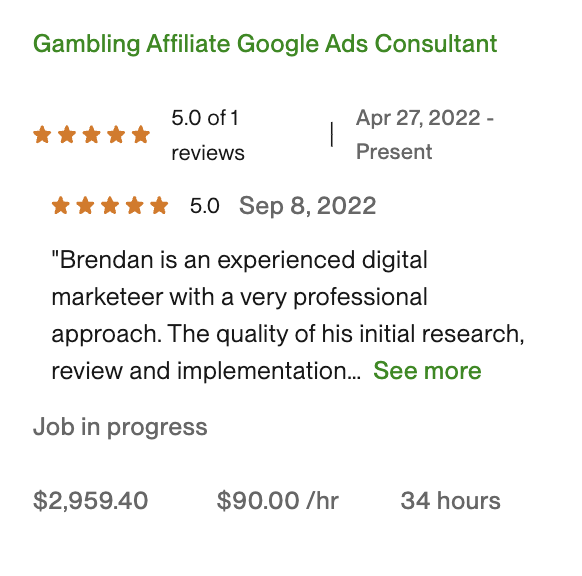
“Brendan is an experienced digital marketeer with a very professional approach.”
Every contract, in full.
Five of those eight were billed at $85 an hour or more, and three are still running. The earliest started in 2022, the most recent this year - this isn't a story about something I used to do.
Seven of the eight ran at roughly four to five hours a week. One didn't, and it's the biggest number here. That's the choice, not a promise: this works around a job, and it scales if you decide to give it more.
What the coaching produced
Three people I coached. Nine clients between them.
Everything above this is mine - my contracts, my rates, my receipts. Which proves I can do it, and proves nothing about whether you can.
So here's the part that matters more. Before this cohort existed, I ran a small informal group - friends and people I knew, taught in exactly the way I'll teach here: how to find clients worth having, and how to package the work so it doesn't eat your week. These are the three people who came out of it.
First client in six weeks. This is where they got to in 6 months.
Nine clients between them. About £3,710 a month, for a little over a day's work each per month. All three are still employed full-time - none of them quit, and none of them intended to.
Look at the effective rate: £96, £100 and £104 an hour. They didn't get lucky at three different levels. They learned the same thing.
Week two is entirely this. You'll leave it with your own skill written up as a package, priced, and scoped so it stays low-touch.
My contracts say I did this. These listings say it's available right now.
Average UK day rate for marketing & communications contractors in 2025, up from £389 in 2024, across 261,000+ freelance contracts.
YunoJuno Freelancer Rates ReportAverage day rate specifically for freelance Biddable Managers - paid search, paid social, programmatic. US equivalent: $60/hour.
YunoJuno - Biddable Manager ratesWhat experienced UK PPC freelancers charge hourly; senior specialists with large-budget track records go to £100–£150.
JH Marketing - UK PPC freelancer costsThird-party benchmarks, not my numbers. The market pays these rates whether or not I exist.
This is what the market pays for what you already do.
Every figure is the 2025 average day rate published by YunoJuno for that job role, drawn from 261,000+ freelance contracts. Category average across marketing & communications: £418/day, up from £389 in 2024.
And the money actually landing in the bank
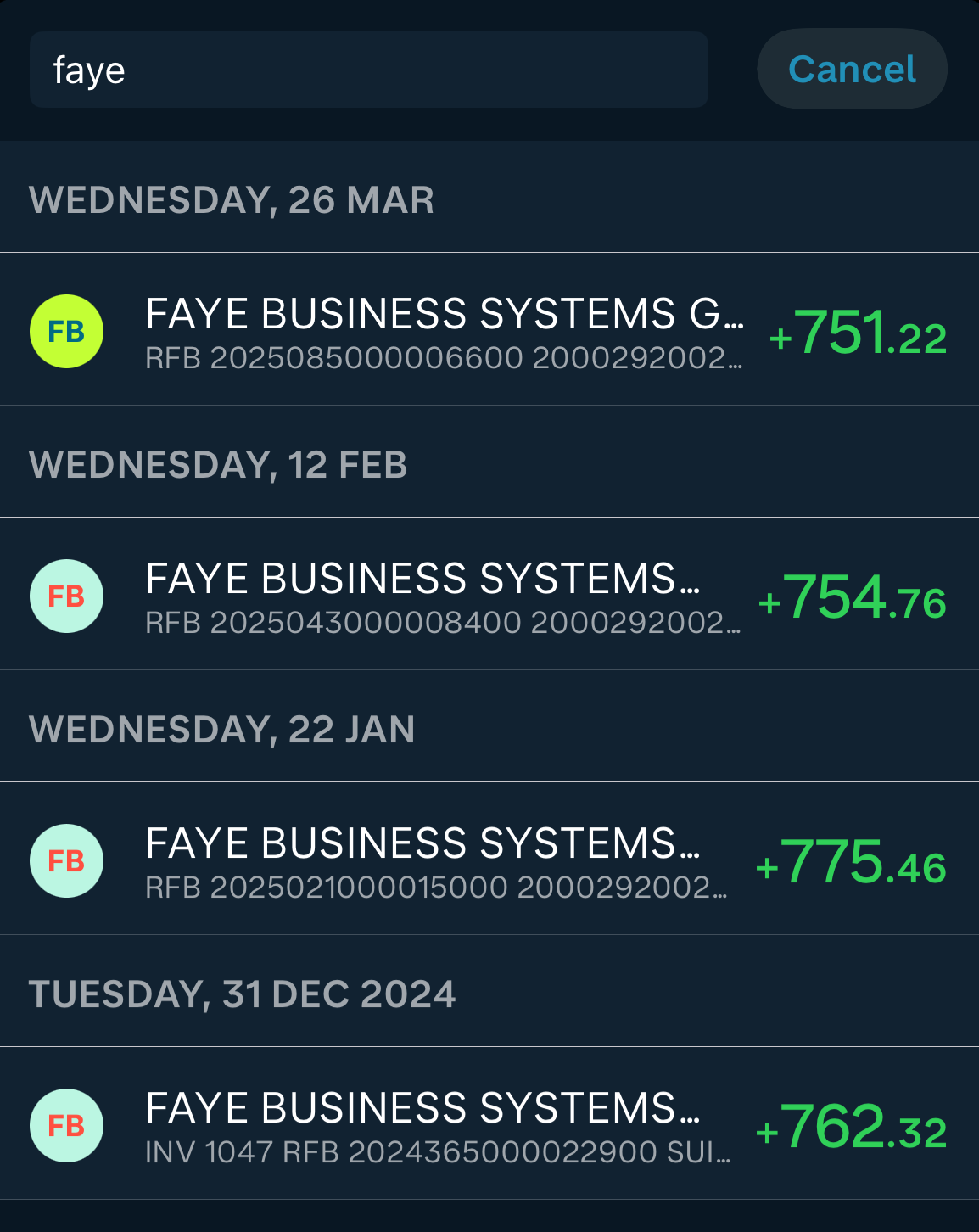
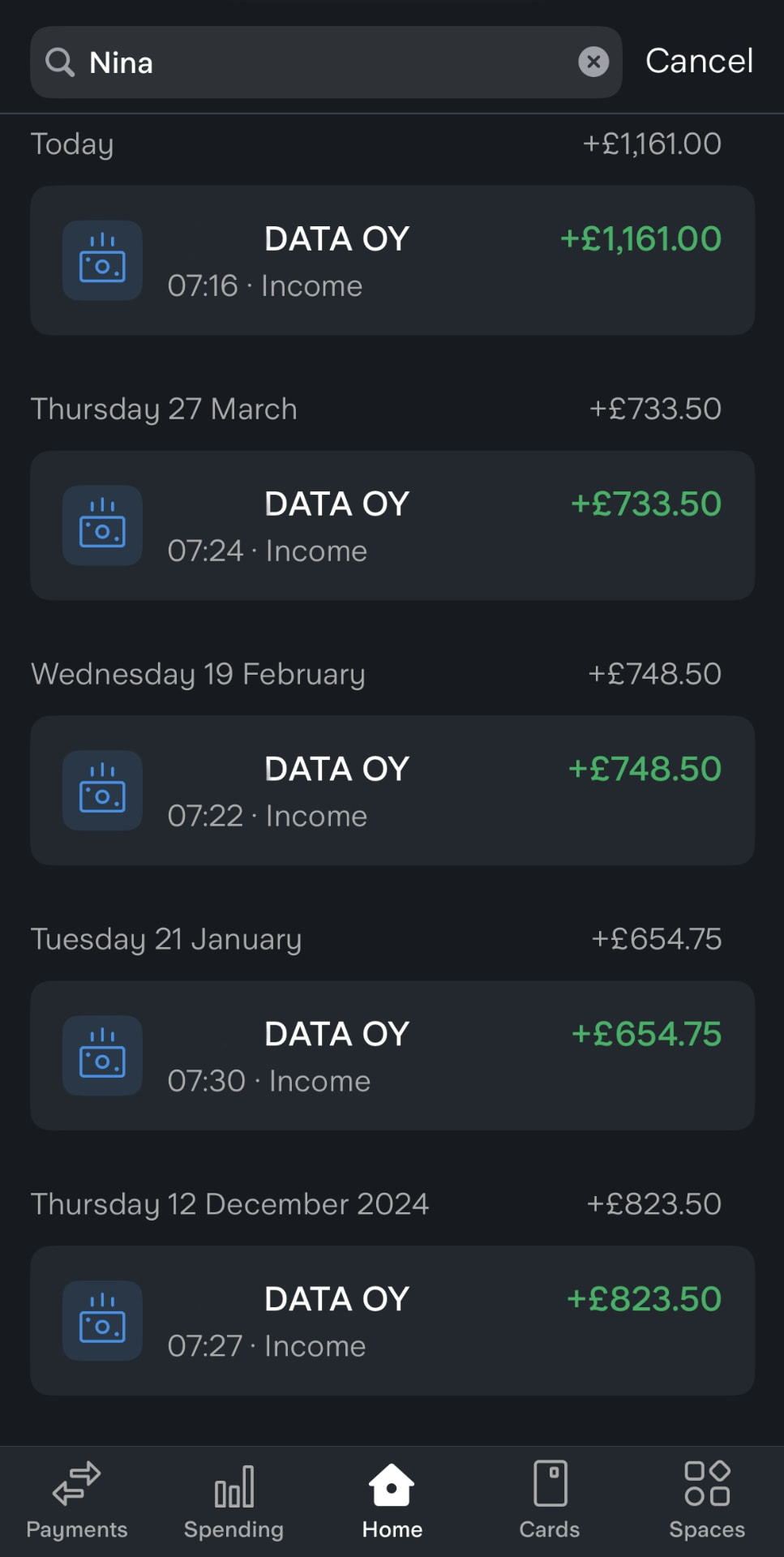
$90 an hour is roughly £69 an hour. If you're on a £45,000 salary, your employer is paying you about £23 an hour for the same skill.
That gap is the entire business. It isn't a secret, it isn't complicated, and most people with a billable skill never close it - because nobody ever showed them how to price it, where to find the client, or what to say on the call.
The numbers
One client pays for your investment.
Across the nine clients the three of them run, the average retainer is £412 a month. One client at that level covers the cohort inside three months, and then keeps paying every month after.
That's the numbers against real billed rates, not a projection of yours.
I'm not promising you a client. I'm showing you what one is worth if you get it, so you can judge the price against something real before you ever see it.
Enrolment closes 24 January · 8 seats
The numbers, for your specialism
Same hours. Two ways to sell them.
The hourly figure uses published freelance day rates for your skill. The retainer figure uses £100 an hour - the effective rate the three people I coached actually achieve, shown above. It's arithmetic on real numbers, not a forecast. Whether you get there depends on finding the client and pricing the conversation properly, which is what the six weeks teach.
Enrolment closes 24 January · 8 seats
Six weeks. £960 to £1,450+ a month, on a few hours a month.
Enrolment closes 24 January · 8 seats
The outcome
What you'll have at the end
Not what you'll have watched. What you'll have built.
A packaged offer, priced.
Your skill written up as something a client can buy monthly rather than hourly. Scoped so it stays low-touch.
A pricing position you can defend.
What to charge, and what to say when someone pushes back on it.
A client list and the outreach to go with it.
Built in week three. Sent in week four.
A discovery call you've actually practised.
Including what to say when they ask your rate, and how to handle “we'll think about it.”
Feedback on your real messages.
Not a template - your words, marked up, before you send the next one.
A first client, or a clear read on why not.
That's the six-week goal. The three people I coached each started with one and are now running two to four, on about twelve hours a month. The first is the hard one - you'll leave knowing exactly how to get the second.
The offer
What you actually get for your investment
Six weeks. Live. Eight people. This is not a course you log into - it's six sessions with me and a small group, built around your actual situation.
Six live group sessions
One a week, 60–90 minutes, on Zoom, at 5:00pm UK / 12:00pm ET. Not pre-recorded. You can ask questions and get answers in the room. All sessions recorded if you miss one.
A six-week plan built for your circumstances
Not a generic curriculum. In week one we map your actual skill, your actual available hours, and your actual constraints - including your employment contract - and you leave with a specific sequence for the five weeks that follow.
Direct feedback on your client outreach
You write the messages, I tell you why they're not landing. This is the part that most separates a cohort from a PDF. Send me what you sent, get it back marked up.
A private group chat for the six weeks, plus ninety days after
Between sessions and beyond. Ask when you're stuck, post when you land something. The chat stays open for three months after the cohort ends, because first clients don't always arrive on schedule.
The templates I actually use
Pricing and packaging structures, discovery call frameworks, outreach messages, client onboarding. Included because they save you time - not stacked up and given a fake dollar value.
Your offer document, written and priced
By the end of week two you'll have your own skill written up as a client-ready offer: what's included, what it costs, what's out of scope, and how it stays low-touch. We refine it across the six weeks. You leave owning it - it's the thing you send to a prospect.
The practical setup you'll actually need
Registering as a sole trader, what to keep for tax, invoicing, and how to check your employment contract before you take a client. Not a module - a short set of guides for the admin nobody warns you about and everyone gets stuck on.
That's the whole offer. No bonuses, no upsells, and nothing withheld for a higher tier - everything above is included for everyone in the cohort.
The curriculum
How the six weeks run
What you can sell, what it's worth, how many hours you actually have. You leave with a written plan and a target rate.
The goal is a signed first client by the end of week six. Some people get there in week three. Some don't get there inside the six weeks - see below, I'm not going to pretend otherwise.
Fit check
Be honest about which one you are
This is for you if:
- +You're employed in marketing in any specialism - paid media, SEO, social, CRM, content, analytics, ecommerce, brand, or as a generalist
- +You can find 4–6 hours a week and you're being realistic about that
- +You want extra income alongside your job, not a leap out of it
- +You're willing to send messages to strangers and be told your first draft is bad
This isn't for you if:
- −You don't yet have a marketable skill - this cohort doesn't teach marketing, it teaches selling the marketing you can already do
- −You want a passive income stream. Freelancing is work you do for money. It's just better-paid work
- −You want to be handed a client list
- −You can't commit to being live on six calls
If you're in the second list, don't book a call. I'd rather you didn't than have you spend the money and be frustrated.
The founder
Who's running this
I'm Brendan. I run paid media - Meta and Google - as my day job, and I've run freelance clients - and coached other people to do the same - alongside full-time employment for over a decade. Not a leap, not a personal brand, not a course funnel. Just clients, invoices, and a few hours a week.
I'm still doing the thing I'm teaching, this month, with real clients and real budgets. Most people selling freelancing advice stopped freelancing a long time ago, which is why their advice sounds like it was written in 2019.
What I'm good at: pricing, positioning, and the unglamorous mechanics of getting a stranger to reply. What I'm not: a mindset coach. There's no morning routine module.
Before you book
What you'll get from your 20-minute call
Whether or not you join, you'll leave the call knowing more than you did.
What your skill is actually worth
We'll look at what you do now and where it sits against current market rates. That's useful to you regardless of what you decide.
Whether the hours work
You tell me what you realistically have. I'll tell you straight whether that's enough, and what it would look like week to week.
How the cohort runs, and what it costs
20 mins - I'll walk you through the six weeks and give you the price on the call. It's a four-figure commitment - if that's out of range, say so early and we'll both save fifteen minutes.
A decision, either way
If it's not a fit, I'll tell you. I'd rather run this with six people who belong in the room than eight who don't. If it is, I'll send the details and you go away and think about it. Nobody pays anything on a first call.
Pick a slot below · 20 minutes · no payment on this page
Enrolment closes 24 January · 8 seats
The refund
Two sessions to decide
Attend the first two sessions, do the work that's set, and if it isn't for you, tell me before session three and I'll refund you in full. After that the material is delivered and refunds aren't available. That's the whole policy - no forms, no conditions buried in a FAQ.
FAQ
The founding price is discussed on the call. It's a four-figure commitment, not a £49 course - if that's immediately out of range, the call will save us both time. I'd rather tell you the number in a conversation where I can also tell you whether it's worth it for your situation.
Straight talk
What I'm not promising
I can't guarantee you'll land a client in six weeks. I don't know your skill level, your market, how many hours you'll really put in, or how well you'll take feedback. Some people in this cohort will finish without a client.
What I can tell you is what's in your control: the plan, the outreach, the pricing, the call structure, and someone experienced telling you where it's going wrong while you're doing it rather than after.
I've done this myself, part-time, around a job, repeatedly. I've taught three other people to do it. I haven't run it as a cohort before - this is the first one, which is exactly why the seats are priced the way they are and why I'm keeping it to eight people.
The cost of waiting
The cost of doing nothing is a number.
Nothing bad happens if you close this page. That's the problem - nothing happens at all.
One retainer at the average of £412 a month is £4,944 over a year, for a few hours of work a month. That's the thing you're deciding about - not a course, a client you either have next year or don't. The next cohort after this one runs in January.
Founding cohort
8 founding seats. Starts 29 January 1970.
This is the first cohort, and I'm making the trade explicit.
For you: the founding price, which is meaningfully below what this costs once there are cohort results to point at. And a group of eight rather than thirty, so there's actual time for your situation in every session.
For me: I want two things from these eight people - a testimonial if it works, and permission to use your numbers the way I've used James's, Abbie's and Jack's. That's why it's priced where it is.
When the eight seats are gone, the next cohort starts in January at the standard price.
Enrolment closes 24 January 1970 · cohort begins 29 January 1970 · 8 seats
Nobody's going to offer you this. That's the whole point.
Your employer isn't going to raise your rate to market. The agency billing your work at £400 a day isn't going to cut you in. The only version of this that happens is the one you go and build, in the hours you already have.
Six weeks. £960 to £1,450+ a month, on a few hours a month.
Enrolment closes 24 January · 8 seats